
 Power Brakes, If some is good and more is better then too much is just right Power Brakes, If some is good and more is better then too much is just right |
|
|

|
Porsche, and the Porsche crest are registered trademarks of Dr. Ing. h.c. F. Porsche AG.
This site is not affiliated with Porsche in any way. Its only purpose is to provide an online forum for car enthusiasts. All other trademarks are property of their respective owners. |
|
|

| Larry.Hubby |
 Nov 4 2017, 09:58 PM Nov 4 2017, 09:58 PM
Post
#1
|
|
Member who doesn't post much, but has a long time in 914s  Group: Members Posts: 191 Joined: 24-November 04 From: Palo Alto, CA Member No.: 3,172 Region Association: Northern California  |
Better brakes is something that seems to be on a lot of our lists of desirable updates for our 914s. This may be because what we really want is more performance and it seems like a good idea to have more stop if you add more go, or it may be one of those “as long as…” phenomena connected with the transition to five-bolt wheels that also seems to be on many people’s lists. Whatever the reason, by “better” we usually mean “bigger”. This is odd in a way, because I recall thinking that the brakes were one of the best things about the stock 914 when I first got my car in May of 1970. Admittedly, the brakes required a rather manly push that the road testers at the time noted as nearly twice what they considered optimum to get their standard of .5g of deceleration, but subjectively, they felt good, at least to me. A firm push on the brake pedal produced more deceleration than I was used to in many other cars of the day, and it wasn’t too easy or difficult to lock up the wheels under panic stop conditions. Care was required, however, when getting back into the family sedan after driving the 914 for a few days not to throw other occupants through the windshield at the first stop light due to the difference in required pedal pressure.
I upgraded my brakes the first time when I made the big transition to a six-cylinder engine and five-bolt wheels in 1981. In changing the front shocks to Bilsteins, I went for whole new struts that have the wider caliper mounting bolt spacing and bought some used aluminum 911S calipers from Aase Bros in Anaheim and new vented discs. For the rear, I bought some used 914-6 calipers (one could still do that for ~$75/each in 1981) from Rich Bontempi in Redwood City, and found some used 911 rear calipers with the spacers for vented discs and some used but still good vented rear 911 discs at a swap meet, robbed the spacers and hardware from the 911 parts and made myself some 914-6GT calipers, turning down the OD of the discs slightly after having them resurfaced to make everything fit. A change to a 19mm brake master cylinder, an adjustable rear brake pressure regulator, and new pads completed the transition to what I felt must be much better brakes. After all, it was essentially the same as what the factory used on the 914-6GT race cars. Imagine my surprise when I first drove the car after the upgrade and, not only didn’t the brakes feel better, they felt worse, significantly worse, and by that I mean it required more pressure on the brake pedal to get the same deceleration as before, and it was nearly impossible to lock the wheels. I was now running 5 ½ inch rims with 185 cross-section tires instead of the original wimpy 155 section tires on 4 ½ inch rims, and the car was ~350lbs heavier than when it was a 1.7L four, but still about the same weight as the 911S which had essentially the same brakes. The wider tires’ greater grip might explain more braking force being required to lock things up, but certainly not the firmer push required for the same deceleration. So, I came up with a list of possible causes. I thought maybe the pads weren’t adequately bedded-in, the pistons might be sticking in the used calipers, maybe a small amount of air was trapped in the lines that I didn’t get out, and/or the rear brake pressure regulator might not be adjusted properly. It took me about a month to chase down all these possibilities, but, to make a long story short, the answers turned out to be, some, no, no, and no. The brakes did improve some after aggressively bedding-in the pads, but everything else checked out OK and the result still seemed a little worse than before in terms of the deceleration obtained for a given force applied to the brake pedal. The brakes were completely useable, I got used to them, but they just didn’t seem better. Still curious as to what was going on, and having exhausted my ideas for physical causes, I decided to go back to freshman physics to look for possible answers. From a simple mechanics point of view, what the brakes do is produce a torque acting on the wheel that opposes its rotation, and hence the motion of the car. I’ll spare you the derivation of the two simple formulas that it results in, the first of which is the equation relating the braking torque to the deceleration produced: D = (g x T)/(W x H) Where, Where, T = k x P x A x RD = deceleration produced (in g’s) g = acceleration due to gravity T = torque exerted by the brake (in ft-lbs) W = weight on the wheel (in lbs) H = rolling radius of the wheel (in ft) An equation like this holds for each of the car’s four wheels. Using these equations to predict the maximum deceleration the brakes can produce for the car as a whole, however, would require knowledge of several additional things, such as exactly how much weight is on each wheel as a function of time, which is tricky because of weight transfer during braking, and the possibility of exceeding the limit of tire adhesion at each wheel. Simply comparing the performance of different brake configurations, however, only requires comparing the torques, T in the above equation, they will produce for the same amount of force on the brake pedal. That is the second simple formula, and it is: T = the torque produced (in ft-lbs) k = coefficient of friction (dimensionless, ~.35 for typical pads according to an old Airheart catalog) P = hydraulic pressure produced by the master cylinder (in psi) = force on the pedal x pedal mechanical advantage /area of master cylinder piston A = total piston area in the caliper = area of one piston x number of pistons (in sq in) R = effective radius at which the gripping force of the piston is applied to the disc (in ft) (Assumed to be the disc radius minus the radius of the caliper piston minus .25”) What, no dependency on pad area? The bigger pads of the larger calipers is largely what gave me the impression that they were going to give me more braking force in the first place. Pad area turns out to cancel out, and all that matters is the piston area. While it’s true that the friction force at the interface between the pad and the disc is proportional to pad area, it’s also proportional to the force per unit area pressing the pad against the disc, which is equal to the force provided by the piston divided by the pad area. Thus the pad area appears in both the numerator and the denominator of the equation and hence cancels. Large pads do produce less fade and wear longer because they have more material to spread the heat and wear over, but they don’t by themselves result in more braking force. So then, what we should look at quantitatively using the formula above is the braking torque produced by various typical 914 brake set-ups for a fixed pedal pressure, say 50 lbs. The following data is gleaned from various Porsche shop manuals. The units of the various relevant quantities have been converted so that the final torque values will be in ft-lbs, as specified above: 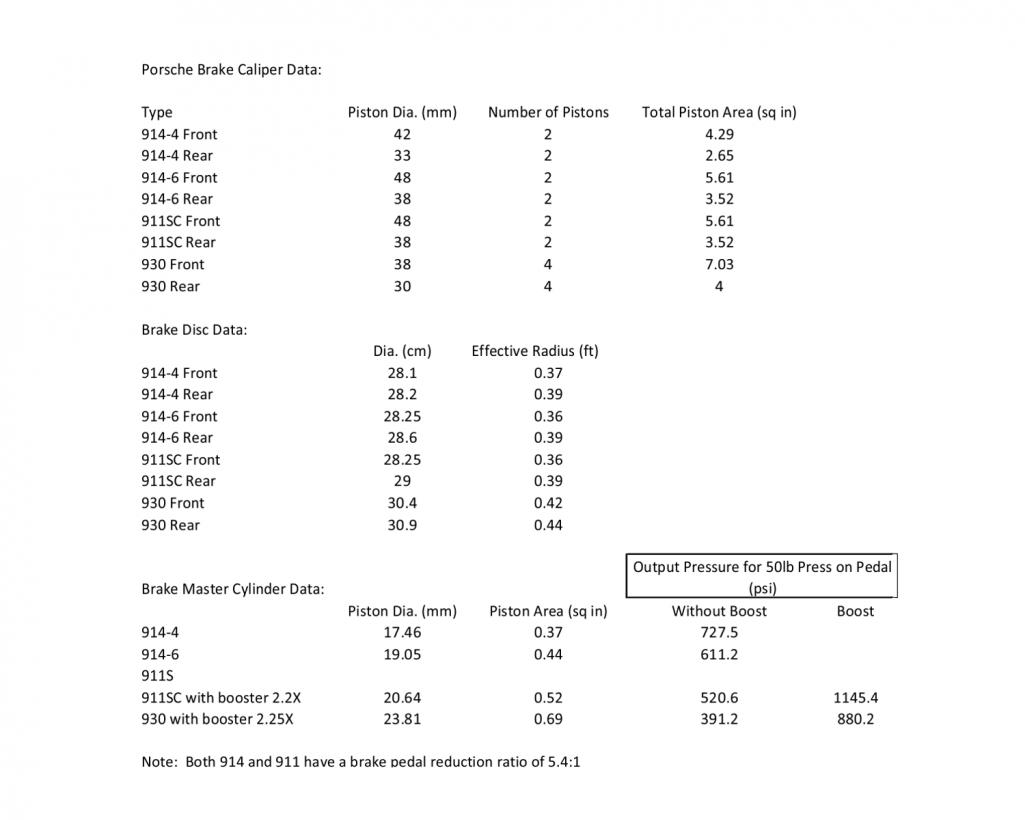 I haven’t included the 911S aluminum calipers in the list because the piston size and associated master cylinder bore size are the same as those for the 914-6 front calipers. The aluminum construction may make the calipers more efficient at heat elimination due to its high thermal conductivity, and definitely reduces un-sprung weight, but neither of these advantages results in more braking force. Substituting the quantities above into the equation for the torque produced, we obtain the following results: 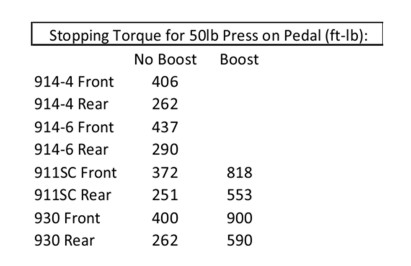 Based on these numbers, we can compare what should happen, relatively speaking, when the driver presses on the brake pedal with 50lbs of pressure for various vehicles of interest: 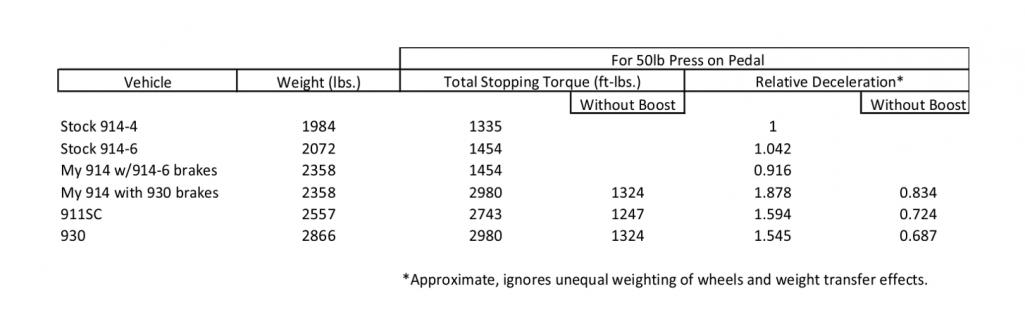 So these results basically confirmed what I was feeling about my brakes, that I actually had less decelerative ability at a given pedal pressure than I had when my car was new in spite of the larger brakes, because of the car’s greater weight and only the about the same amount of actual braking force. I suppose it should have been obvious as soon as I worked out the formula above for the braking torque. Because there must be a constant gap, called the “venting clearance”, between the pads and the brake disc, independent of caliper piston and pad size, when the brakes are not applied to avoid drag, and because the motion of the brake pedal must first displace sufficient fluid to move the caliper pistons into contact with the disc before any braking force can be developed, increasing the diameter of the caliper pistons generally requires an increase in the diameter of the master cylinder such that the ratio of the two areas remain the same. When that is done the mechanical advantage of the hydraulic system also remains the same, and the braking force for a given amount of force on the pedal remains the same. An alternative way of stating this is that, if the amounts of the venting clearance and the allowable pedal travel are fixed, then the overall mechanical advantage is also fixed, no matter how big the calipers, and the only ways to produce more braking force is to either push harder on the pedal or add something which increases the force without increasing the pedal travel, which is what the vacuum boosters on most modern cars do. There is some leeway in this relationship, but any under-sizing of the master cylinder in order to get more mechanical advantage, and hence more braking force, will have to be paid for by increased pedal travel before the brakes take hold, and likewise any over-sizing of the master cylinder in order to get less pedal travel will result in less mechanical advantage and hence less braking force. You can see that there has been some playing with this relationship for the vehicles we’ve been considering by calculating the caliper piston/master cylinder piston area ratio for each: 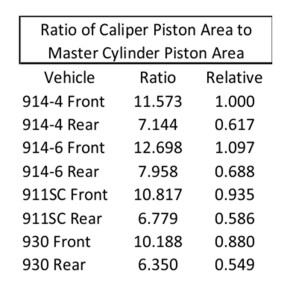 You can see from this that the 914-6 gets its slightly (~10%) increased braking force compared to the stock 914-4 from the fact that its master cylinder is slightly undersized compared to its caliper pistons, but the increase in pedal travel required is then also only ~10%, which is no doubt tolerable. Also, the cars on this list that Porsche has delivered with a vacuum booster, the 911SC and 930 models, have somewhat oversize master cylinders (19.95mm and 22.34mm master cylinders for the 911SC and 930, respectively, would give them the same ratio as the 914-4), which, failing their boosters, would result in less braking force, but also less pedal travel. According to the numbers above, a 930 without a brake booster but with the same size master cylinder as stock might produce more than 30% less deceleration than a humble 914-4 for the same push on the brake pedal, but it actually delivers 55% more because of its booster. The same brakes, however, on a much lighter 914 (one with near stock weight) without a booster might produce just about the same deceleration as the stock system, and on my heavier 914 the 930 set up with the booster would improve what I had before by just slightly more than a factor of two. The advent of boosted brakes on production Porsches seems to coincide with the dramatic increase in their weight that began in about 1975 with the early 930 and 2.7 911s, probably driven in large part by safety regulations that took hold about then. What all of this proves I suppose, is that our bigger, better brakes are better almost exclusively in the sense of being less subject to fade because of greater heat removal capability, and that is a big advantage only if you’re using the brakes heavily enough to be encountering fade. Some of us do that routinely, and all of us do that occasionally, so the effort and expense of going to the bigger brakes is not wasted, it’s just more valuable to some of us than to others. For my money, and my typical usage, more deceleration for the same pedal effort is more useful and more desirable than the greater resistance to fade, but, why not have both? Like I typically say, if some is good and more is better, then too much is what you really want. I started plotting to add a vacuum booster to my brakes even before I really understood what I’ve just explained, about 1990. Initially I was intending to add just the 911SC boosted master cylinder setup, but my efforts kicked into high gear when I acquired a set of 930 front calipers and rotors at a swap meet that same year. Now committed to the full 930 setup, I slowly acquired the remaining parts and was ready to get serious about installing them about two years later. The problem was where to put the booster/master cylinder due to the tight space in which the stock master cylinder is mounted. In the 911/930 the factory had the same problem and solved it by moving the booster and master cylinder to the front trunk just above the pedals, connecting the two with a mechanical linkage consisting of a strap, a push rod, and a reversing lever mounted in a casting that supports the entire assembly. This is not an option on the 914 because the corresponding area above the pedals is occupied by the gas tank. Compared to the 914, the 911 has the front trunk area and the gas tank location swapped. The boosted master cylinder is large enough that the front trunk space is the only feasible location for it, and there is room in the 914 to mount it there, but the problem then becomes how to deliver the force from the brake pedal to it. Initially, I thought of doing this hydraulically, using a 944 clutch slave cylinder and the existing 19mm brake master cylinder, which happens to have the same diameter as the 944 clutch master. This would allow me to mount the boosted master cylinder assembly almost anywhere. Unfortunately clutch slave cylinders aren’t suitable for this, at least the 944 ones aren’t, because they contain springs which maintain a slight pressure on whatever they’re pushing on even in absence of hydraulic pressure in order to take up slack due to wear in the clutch and thus make it self-adjusting. This spring pressure is enough to push the brake pads into contact with the discs and create drag, so it had to be eliminated. I tried to do that by taking one of the slave cylinders apart and removing the spring, and the result worked…sort of. I played around with this set-up for several months, bleeding and adjusting, but never got it to work fully satisfactorily. The pedal always seemed slightly spongey and the maximum braking force was definitely less than it should have been, as though there was some air still trapped in the system somewhere in spite of my aggressive bleeding on multiple occasions. Perhaps I damaged the slave cylinder removing the spring and small scratches were allowing air to seep back into the system, or some such thing. At any rate, I got tired of fighting it and resolved to go to an all-mechanical system, as the factory had. There did appear to be a path to sneak such a mechanical linkage into the front trunk from the brake pedal location just above the front suspension cross member and just below the steering rack, however two factors prevented it from being a straight shot that could be accomplished with a single link. The first is the eleven degree downward slope of the stock master cylinder, there presumably to allow trapped air to vent during bleeding. Since the path from the hole in the firewall for the brake push rod to the target location above the suspension cross member slopes upward at about four degrees, a fifteen degree vertical kink in the linkage is needed at this point. The second problem is that placing the boosted master cylinder in-line side to side with the stock master cylinder location puts it about four inches out toward the middle of the front trunk, consuming far too much of the trunk’s available space. In my case, I had already mounted the booster assembly hard against the driver’s side of the trunk cavity to keep it as far out of the way as possible, thinking I had the flexibility of the hydraulic link to work with. Now doing the job mechanically, I needed a second relay in my linkage, this one to transfer the push four inches toward the driver’s side to line up with the reversing lever in the stock 930 casting. The entire path then was to look like this: 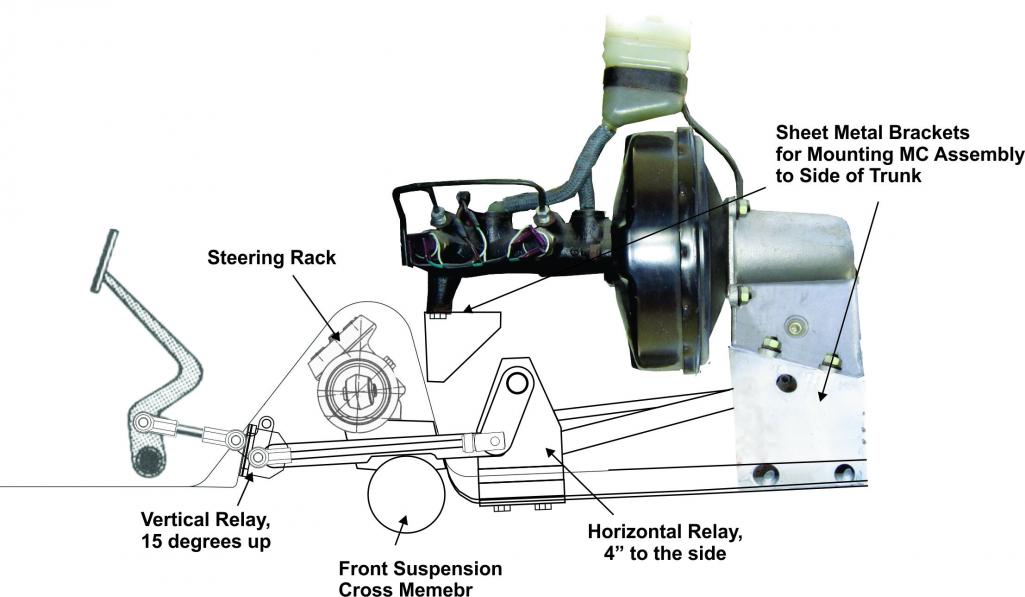 The vertical relay consists of a short lever hinged about a point just above the opening for the brake cylinder to which two 10mm rod ends are attached. 10mm threaded rods connect the first to the brake pedal in place of the normal push rod that operates the stock master cylinder, and the second to the input lever of the horizontal relay. A “U” shaped bracket that mounts to the existing master cylinder mounting studs supports bushings that in turn support a shaft to which the relay lever is attached. A second bracket mounts to the same two studs underneath the one for the relay lever, anchoring a 1” x ¼” steel strap that holds the distance between the two relays rigidly constant. A short section of this strap is reduced in width to ¾” to clear the suspension cross member. The following four photos show the vertical relay assembly prior to installation, a close-up of the vertical relay lever assembly, and the completed link from beneath the car and from the pedals side of the firewall: 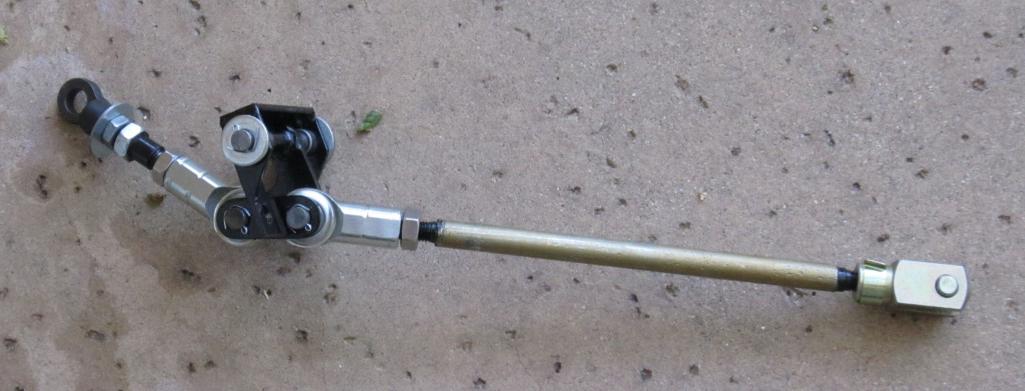 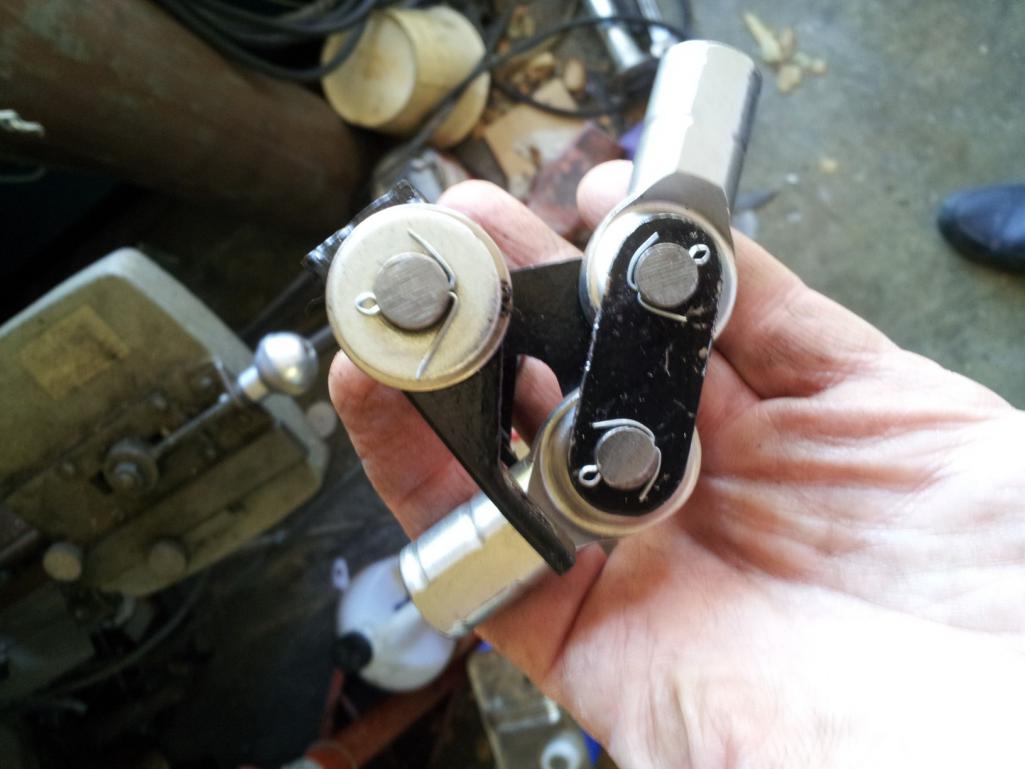 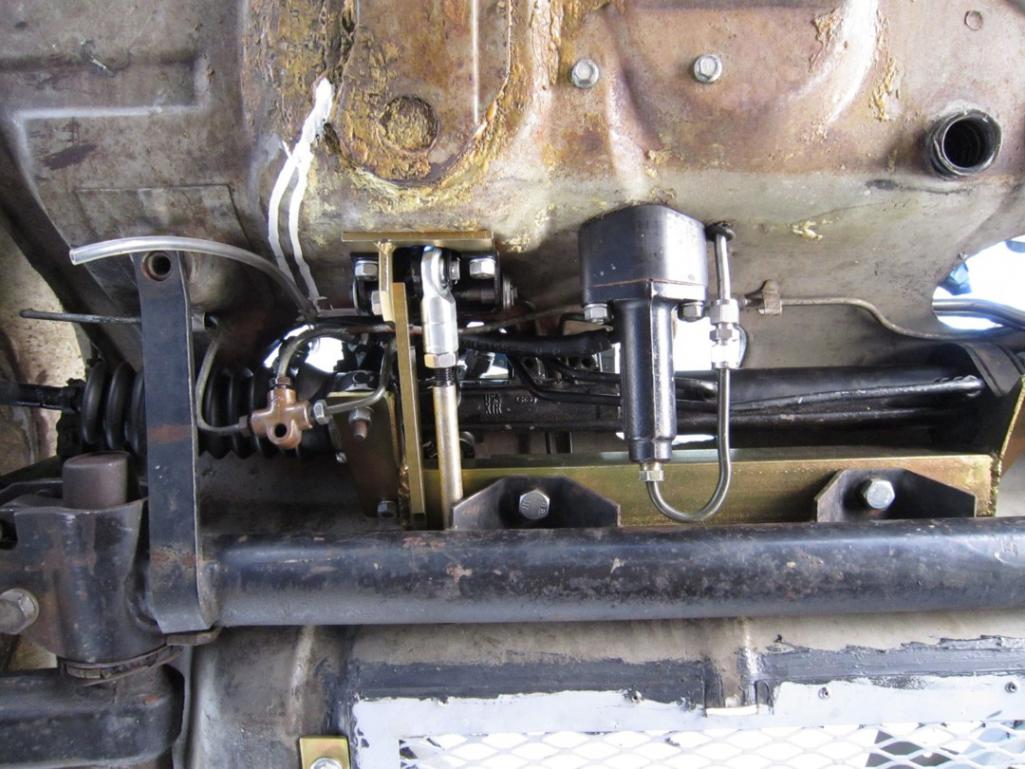 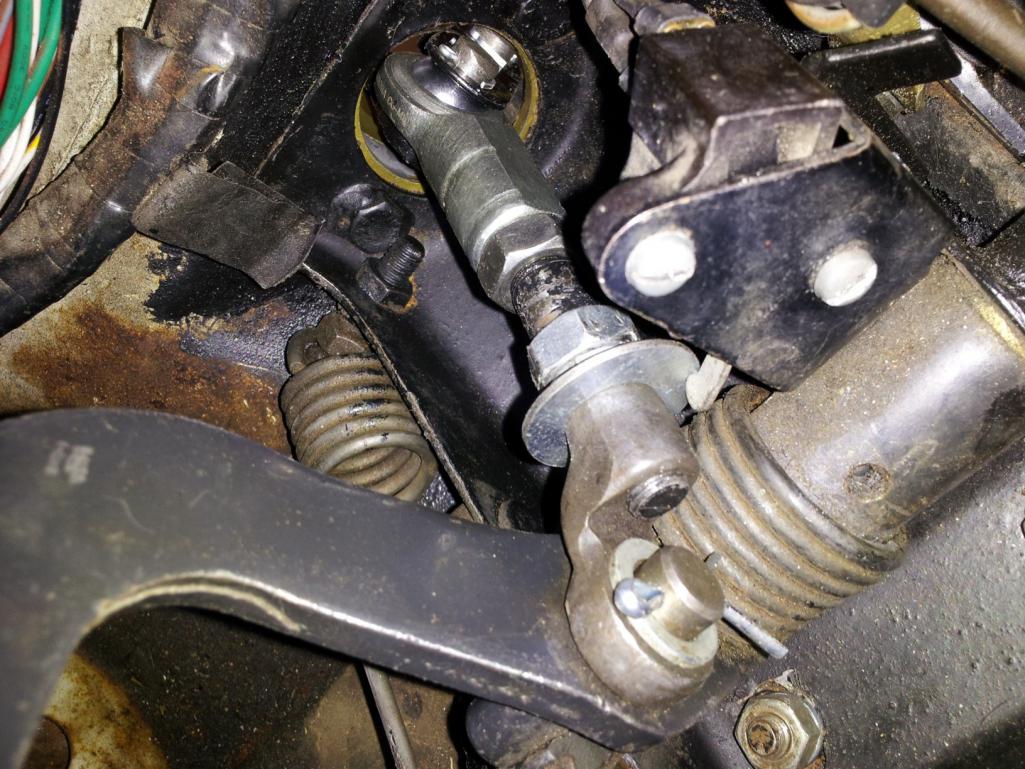 The horizontal relay consists of an aluminum structure that supports a ¾” horizontal shaft in two bushings and anchors both the strap from the vertical relay and another similar strap connecting the structure to the Porsche casting housing the turnaround lever that actuates the master cylinder. I took this photo during the construction of my air conditioner, but it shows the horizontal relay structure fairly well: 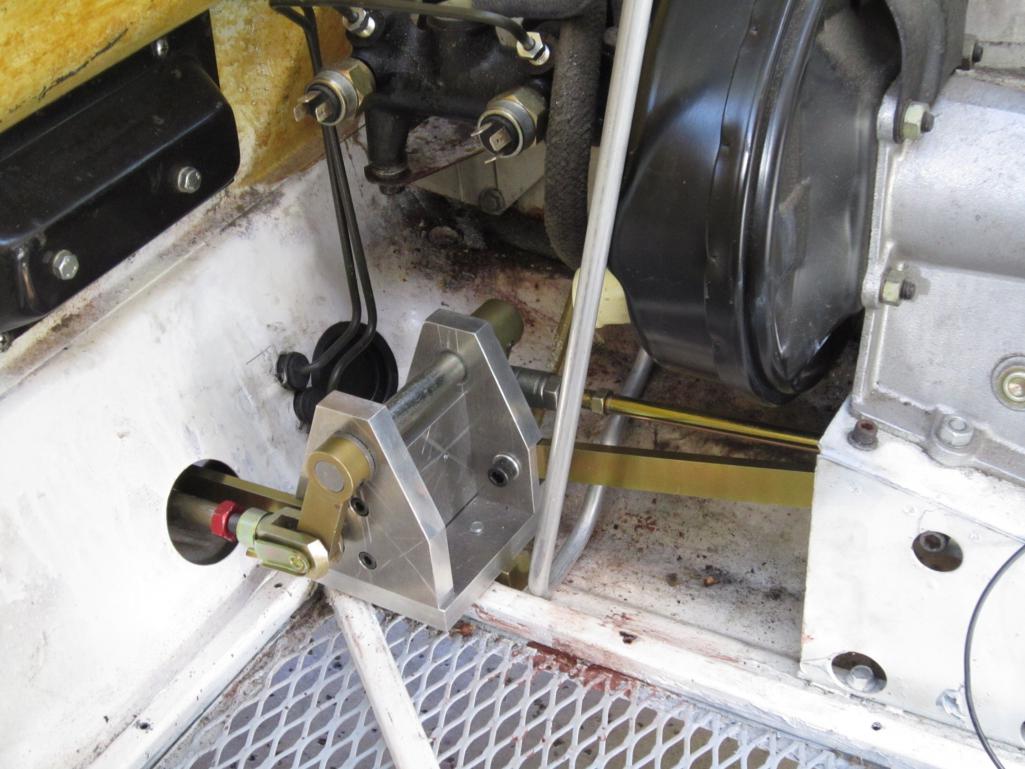 If you look closely you’ll see that the two levers on opposite sides of the horizontal relay are of different lengths. This is an artifact of my initial attempt to use a hydraulic, rather than a mechanical link. The 944 clutch slave cylinder has a different bore diameter than its master, causing a mechanical reduction which I compensated for by attaching the final push rod part way up the turnaround lever instead of at the end. When I went to the mechanical system, I used a shortened lever on the output side of the horizontal relay to mimic this reduction rather than relocating the push rod on the turnaround lever. Why not a single angled link from the vertical relay to the turnaround lever? It might work, but I had concerns about how to hold everything rigid in spite of the sideways force that would be developed, there would be a reduction in the braking force because only a component of the relayed pedal force would be in the direction that actuates the master cylinder, and, as you can see from the photo of the link from underneath the car, in my case the angled path is blocked by a bracket I had to use to mount my power steering rack, although there might be room for it on a car with the normal rack. In spite of its apparent complexity, this mechanical system works well and is easy to adjust. The red nut visible in the photo above is the adjusting point. It’s attached to the rod that links the two relays with Loctite red so that turning it turns the whole rod, which is threaded as a turnbuckle with a left-hand threaded rod end on the vertical relay end and a right-hand threaded clevis on the opposite end. |
   |

 
|
Posts in this topic


  |
1 User(s) are reading this topic (1 Guests and 0 Anonymous Users)
0 Members:

|
Lo-Fi Version | Time is now: 2nd April 2026 - 01:06 PM |
Invision Power Board
v9.1.4 © 2026 IPS, Inc.