
 Head Re-Installation Questions Head Re-Installation Questions |
|
|

|
Porsche, and the Porsche crest are registered trademarks of Dr. Ing. h.c. F. Porsche AG.
This site is not affiliated with Porsche in any way. Its only purpose is to provide an online forum for car enthusiasts. All other trademarks are property of their respective owners. |
|
|
  |

| frank_c |
 Feb 23 2026, 12:21 AM Feb 23 2026, 12:21 AM
Post
#1
|
|
Member  Group: Members Posts: 60 Joined: 29-December 24 From: Austin, TX Member No.: 28,542 Region Association: None  |
I received my cylinder head back from having a valve replaced, and have a couple of questions regarding re-installing it.
Note: the #4 intake valve was replaced due to the adjuster wearing the tip of the valve as posted in this thread: http://www.914world.com/bbs2/index.php?showtopic=377159. There were no issues with either cylinder leaking at the base or the head, and no other work was performed to the head. Also, I left the cylinders as-is on the studs after removing the head. 1. Since the head was not machined, there was no issue with either cylinder leaking when the head was removed, and the cylinders were not removed during this time, is there any 'prep work' that needs to be done either at the cylinder/case interface, or the cylinder/head interface, before bolting the head back on? 2. Is Loctite 574 a good sealant to use under the four head stud washers that are under the valve cover (it's what I have on hand)? It looks like a black RTV was used previously, and that was starting to lose its adhesion. |
   |

 
|
| barefoot |
Feb 23 2026, 06:02 AM
Post
#2
|
|
Senior Member Group: Members Posts: 1,480 Joined: 19-March 13 From: Charleston SC Member No.: 15,673 Region Association: South East States 
|
Look closely at the head sealing surfaces to the cylinders. If any doubt I'd pull 1 cylinder and lap the cylinder to the head -rotary motion only. Need lapping compound of course .
Barefoot |
 |
|
| frank_c |
Feb 23 2026, 11:34 AM
Post
#3
|
|
Member Group: Members Posts: 60 Joined: 29-December 24 From: Austin, TX Member No.: 28,542 Region Association: None |
From what I can tell, the cylinder mating surfaces on the head look clean.
My primary concern was the cylinders to case seal. As you can see in the photo, it looks like a hi-temp RTV was used in this area when the engine was rebuilt sometime in the past. I was considering removing the cylinders and old sealant, and then applying Curil T2 (K2 appears to be NLA) to re-seal the cylinders & spacers to the case. However, since I had no leaks in this area prior to removing the head, I'm inclined to "let sleeping dogs lie", and just leave it as-is unless the brain-trust here states that this will almost surely result in a leak since the cylinders have been disturbed slightly by removing the head. 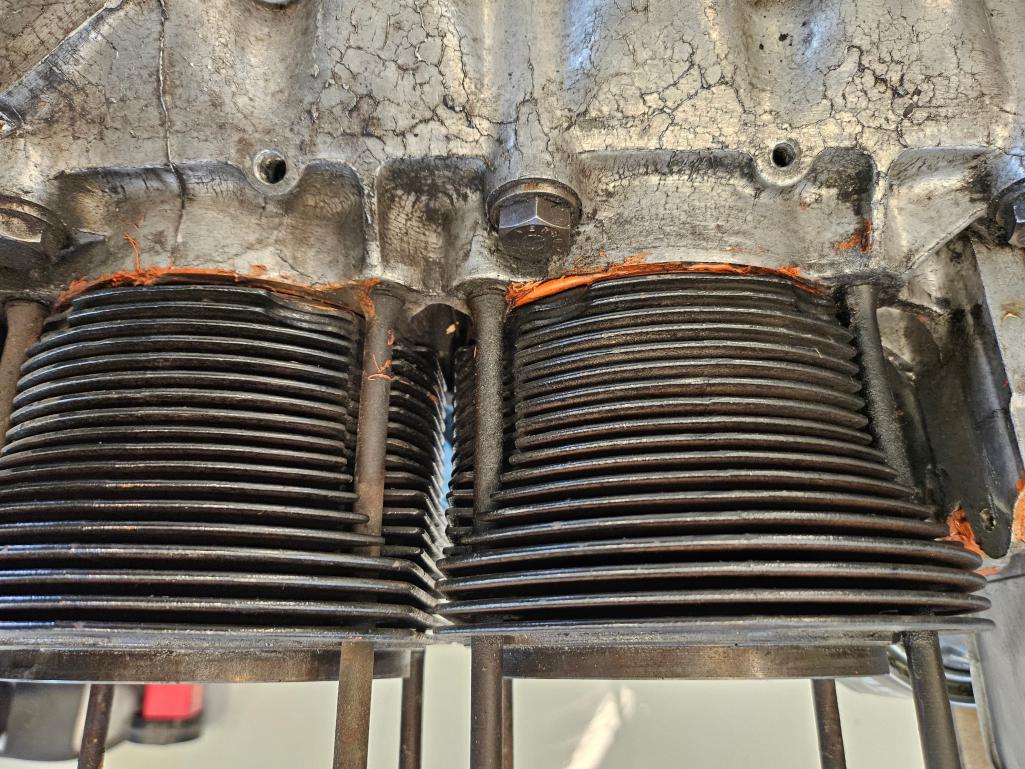 |
|
|
|
| Ninja |
Feb 23 2026, 11:45 AM
Post
#4
|
|
Member Group: Members Posts: 148 Joined: 25-September 25 From: Granbury Texas Member No.: 29,004 Region Association: Southwest Region |
If you are using the upper sealing ring (I call them fire rings, some would call them head gaskets) you will probably be OK.
These rings deform and seal up minor issues. The "now correct" use of NOTHING between the barrel and the head really requires the heads be fly cut. I consider fly cutting as an "always do" step. Personally (going cheap)I would remove all of the jugs and rings, keep them in order and direction, clean the crap out of everything, use some kind of sealant between jugs and case, lap the jugs into their respective heads, and use the fire rings if I was not changing deck height for direct to head (no fire rings) application. Doing it "right" includes both the head (fly cut) and "decking" the cases as the mounting surface on the cases tends to sag with age. At this point you should be changing the thickness of the jug to case seals to achieve .040-.050 deck height. No fire rings are used in the above process. Raby is adamant in NOT using fire rings! But in a real-world scenario where we are trying to minimize costs, I would try a real good clean up with the fire rings. This is for a base engine only, if your running 96mm bores I go Full Monty as the head sealing surface reduces by 50%. Hope this helps! |
|
|
|
|
5 User(s) are reading this topic (2 Guests and 0 Anonymous Users)

|
Lo-Fi Version | Time is now: 23rd February 2026 - 12:21 PM |
Invision Power Board
v9.1.4 © 2026 IPS, Inc.