

 Does the VDO CHT Gauge use a K or J-Type Thermocouple? Does the VDO CHT Gauge use a K or J-Type Thermocouple? |
|
|

|
Porsche, and the Porsche crest are registered trademarks of Dr. Ing. h.c. F. Porsche AG.
This site is not affiliated with Porsche in any way. Its only purpose is to provide an online forum for car enthusiasts. All other trademarks are property of their respective owners. |
|
|
  |
| frank_c |
 Jul 17 2026, 10:10 PM Jul 17 2026, 10:10 PM
Post
#21
|
|
Member  Group: Members Posts: 105 Joined: 29-December 24 From: Austin, TX Member No.: 28,542 Region Association: None  |
QUOTE(barefoot @ Jul 17 2026, 04:17 PM)  Don't you have enough lead to pull the TC out thru the spark plug hole ? The sensor lead is clipped to head cooling fins (see the photo of the installation in my first post of this thread). The clips have a pretty firm grip, plus I have little to no chance of getting those clips back on through the spark plug holes. |
   |

 
|
| frank_c |
Jul 17 2026, 10:20 PM
Post
#22
|
|
Member Group: Members Posts: 105 Joined: 29-December 24 From: Austin, TX Member No.: 28,542 Region Association: None |
Btw, one item I haven't posted yet is the K-Type thermocouple I installed. I went with the one shown below from Auber Instruments as it allowed me to bend the lead up out of the recess for the spark plug, and the clips I used hold the spark plug ring in firmly.
https://www.auberins.com/index.php?main_pag...products_id=137 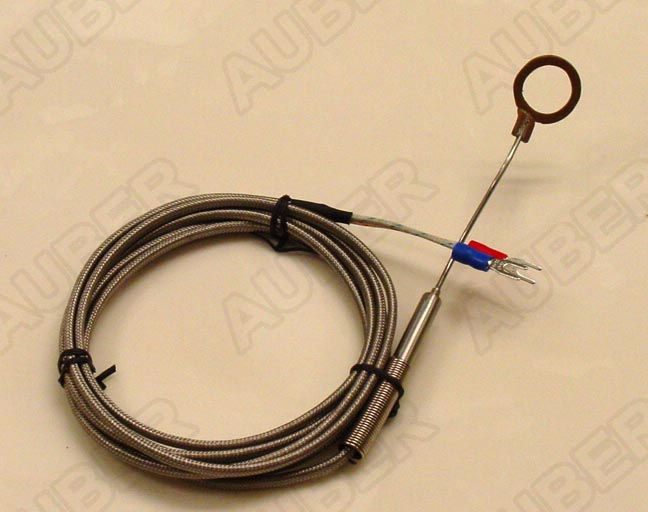 Reposting photo of installation for reference. Notice the now empty CHT boss to the right of #3 plug where old CHT sensor was installed. 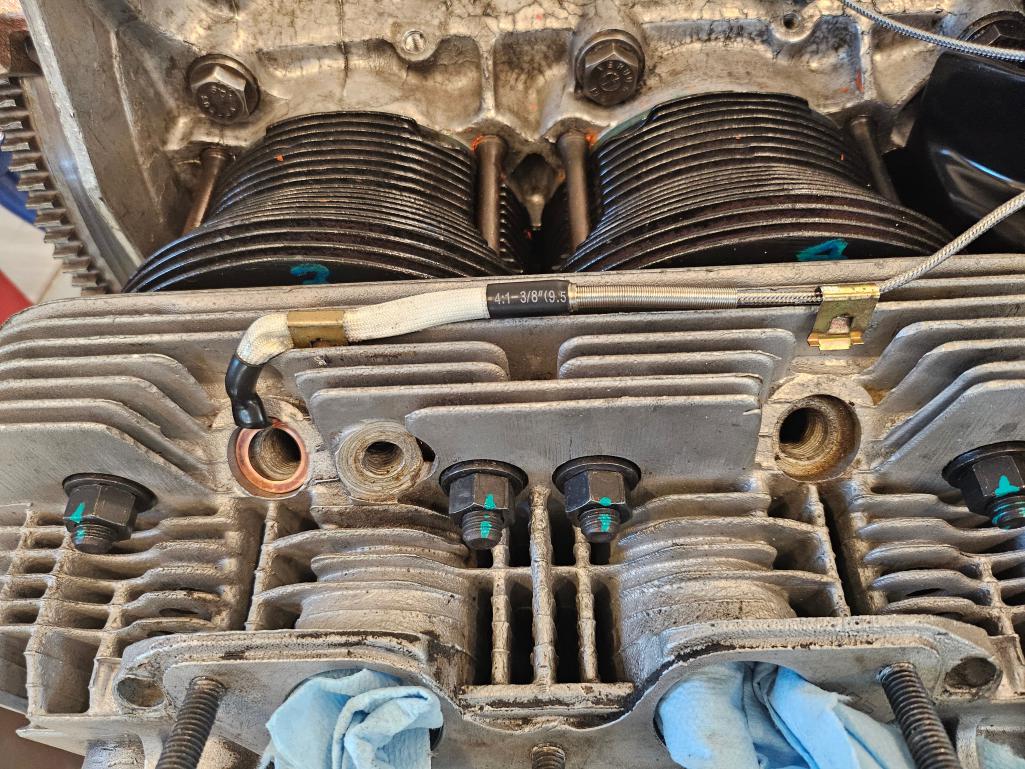 |
|
|
|
| Literati914 |
Jul 18 2026, 09:48 AM
Post
#23
|
|
Advanced Member Group: Members Posts: 2,355 Joined: 16-November 06 From: Dallas, TX Member No.: 7,222 Region Association: Southwest Region |
FOR WHAT IT's WORTH... AI thinks it's K :
"..The older VDO 100°F to 600°F Cylinder Head Temperature (CHT) gauges and senders use a Type K thermocouple wire. The under-spark-plug sensor ring creates a small millivoltage based on the Type K calibration, which the gauge then measures and displays. Keep the following specific characteristics in mind if you are working with or repairing the wiring on this gauge: Cold Junction Compensation: The factory VDO unit utilizes a "cold-junction-compensated" system. It is specifically calibrated to assume a reference temperature (usually around 75°F) at the wire connection point near the engine bay. Wire Composition: Because it relies on the Type K voltage (Nickel-Chromium vs. Nickel-Aluminum), you must maintain the thermocouple wire all the way to the sender. The original VDO wiring typically consists of a short 12-inch Type K section coming from the spark plug ring, which is then connected to standard copper wiring via a duplex solderless receptacle. .." |
|
|
|
| Ninja |
Jul 18 2026, 09:58 AM
Post
#24
|
|
Member Group: Members Posts: 249 Joined: 25-September 25 From: Granbury Texas Member No.: 29,004 Region Association: Southwest Region |
Just a note to THANK everyone who has posted in this thread.
I don't have enough experience to add to the knowledge base, but you guys sure do! I've gained more knowledge on thermocouples in this thread than any other I've read. Excellent info Sirs! (IMG:style_emoticons/default/ninja.gif) |
|
|
|
| Montreal914 |
Jul 18 2026, 10:33 AM
Post
#25
|
|
Advanced Member Group: Members Posts: 2,174 Joined: 8-August 10 From: Claremont, CA Member No.: 12,023 Region Association: Southern California 
|
QUOTE(Literati914 @ Jul 18 2026, 08:48 AM) FOR WHAT IT's WORTH... AI thinks it's K : "..The older VDO 100°F to 600°F Cylinder Head Temperature (CHT) gauges and senders use a Type K thermocouple wire. The under-spark-plug sensor ring creates a small millivoltage based on the Type K calibration, which the gauge then measures and displays. Keep the following specific characteristics in mind if you are working with or repairing the wiring on this gauge: Cold Junction Compensation: The factory VDO unit utilizes a "cold-junction-compensated" system. It is specifically calibrated to assume a reference temperature (usually around 75°F) at the wire connection point near the engine bay. Wire Composition: Because it relies on the Type K voltage (Nickel-Chromium vs. Nickel-Aluminum), you must maintain the thermocouple wire all the way to the sender. The original VDO wiring typically consists of a short 12-inch Type K section coming from the spark plug ring, which is then connected to standard copper wiring via a duplex solderless receptacle. .." Typical AI BS... (IMG:style_emoticons/default/rolleyes.gif) Here is a much better read: https://www.fluke.com/en-us/learn/blog/cali...BdzoFt7xw6Bv5cG |
 |
|
| Superhawk996 |
Jul 18 2026, 01:16 PM
Post
#26
|
|
914 Guru Group: Members Posts: 7,959 Joined: 25-August 18 From: Woods of N. Idaho Member No.: 22,428 Region Association: Galt's Gulch
|
QUOTE(Montreal914 @ Jul 18 2026, 12:33 PM) QUOTE(Literati914 @ Jul 18 2026, 08:48 AM) FOR WHAT IT's WORTH... AI thinks it's K : Typical AI BS... (IMG:style_emoticons/default/rolleyes.gif) Yup - if enough of us all start posting across multiple forums that the VDO uses a type BS sensor . . . It will regurgitate that answer. AI can be useful sometimes just to summarize what the internet has to say, but woe to anyone that takes it as gospel. I’ll do a post later about how to determine sensitivity and to see how accurate the VDO is with a K-type TC that I have on hand. Will dig thru my bench but I don’t think I have any J-type on hand. |
|
|
|
| Ninja |
Jul 18 2026, 01:39 PM
Post
#27
|
|
Member Group: Members Posts: 249 Joined: 25-September 25 From: Granbury Texas Member No.: 29,004 Region Association: Southwest Region |
A bit of info that I can pass along...
I once took every temperature measuring device in a large shop and placed them into a cooler filled with 1/2 ice, 1/2 water, and 1/2 beer/sodas. This cooler should have shown temps in the 32.5-34.5 range. ALL of the old school mercury/glass thermometers were dead nut accurate, even the cheap ass ones. All of the electronic critters were NOT! Even a very expensive Snap-On pyrometer with specific measuring probes (had one for liquid) wasn't nearly as accurate as a $2 glass thermometer... I use electronic thermometers daily in my AC business. I use the "adjustable" type BUT I adjust them in my shop refrigerator against old school glass thermometers I keep in the fridge. The LEAST accurate were the distance IR thermometers (Point and shoot, never touches the item being checked) but all of the electric meters were far enough off to classified NOT ACCURATE in my book. There was a post earlier in this thread about verifing accuracy with boiling water. (IMG:style_emoticons/default/agree.gif) (IMG:style_emoticons/default/agree.gif) (IMG:style_emoticons/default/agree.gif) (IMG:style_emoticons/default/agree.gif) I'd go farther... Boiling water, ambient, refrigerator, and the freezer would be my reference points, and I'd use a glass thermometer as my "standard". One of my Golden rules is "Always test your test equipment". (IMG:style_emoticons/default/ninja.gif) |
|
|
|
| Literati914 |
Jul 18 2026, 01:43 PM
Post
#28
|
|
Advanced Member Group: Members Posts: 2,355 Joined: 16-November 06 From: Dallas, TX Member No.: 7,222 Region Association: Southwest Region |
Of course I agree regarding the Ai comments - but then again, AI got that answer/opinion from people stating it as their experience. It didn't say sometimes it's this or that. I might not hang my hat on it, hence the "take it for what it's worth" comment.
But, also is it just my imagination or isn't most of these CHT gauges used in very similar applications, also using a K type TC ? |
|
|
|
| Superhawk996 |
Jul 18 2026, 05:01 PM
Post
#29
|
|
914 Guru Group: Members Posts: 7,959 Joined: 25-August 18 From: Woods of N. Idaho Member No.: 22,428 Region Association: Galt's Gulch
|
Alright so I’m tight on time but got a little done. As I thought I don’t have any J type TC wire on hand.
Checked my Fluke TC reader in an ice bath - it’s spot on. 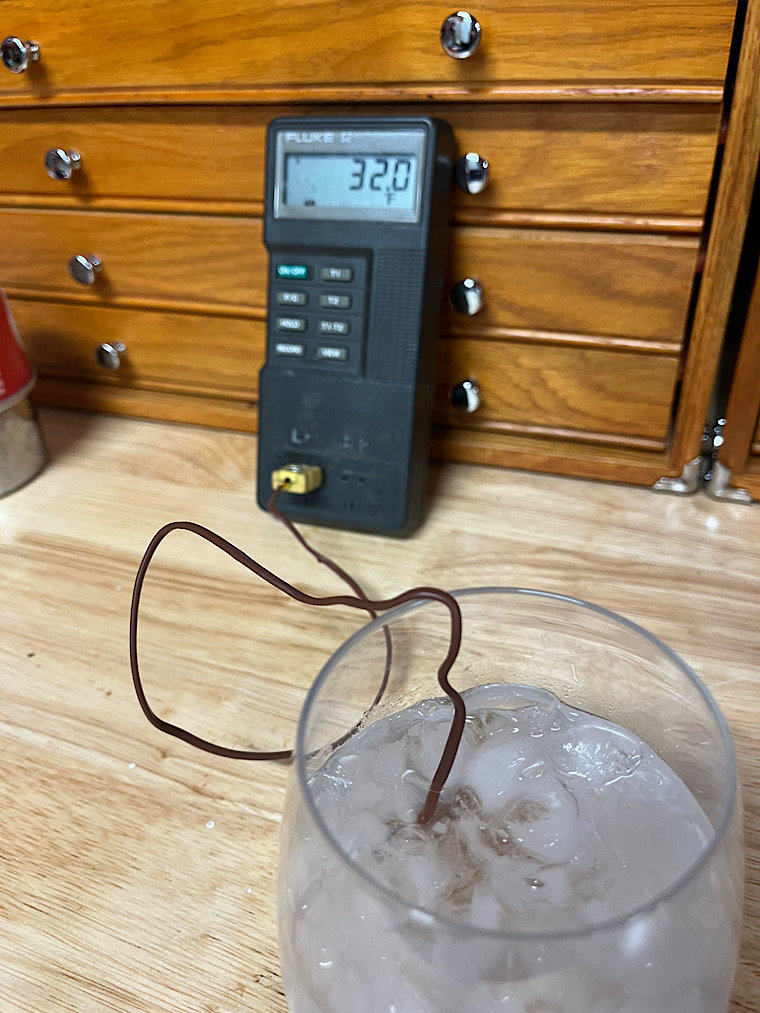 Here’s the set up. Motor oil bath heated to 400F with one K type TC to the Fluke and the other K type TC routed to the VDO CHT gauge. The K type is run directly to the back of the VDO CHT gauge. 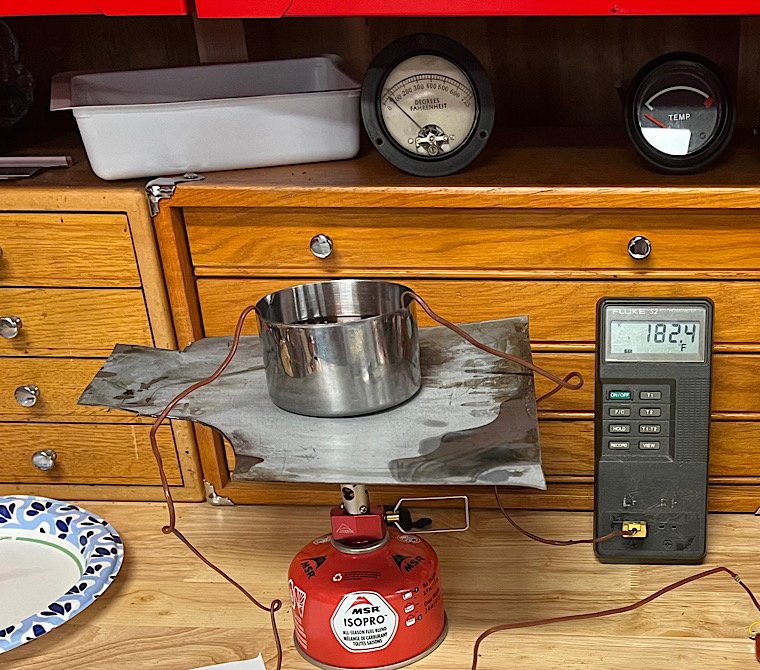 Here’s the VDO Gauge at 400F oil temp but the gauge only showing approx 275F. 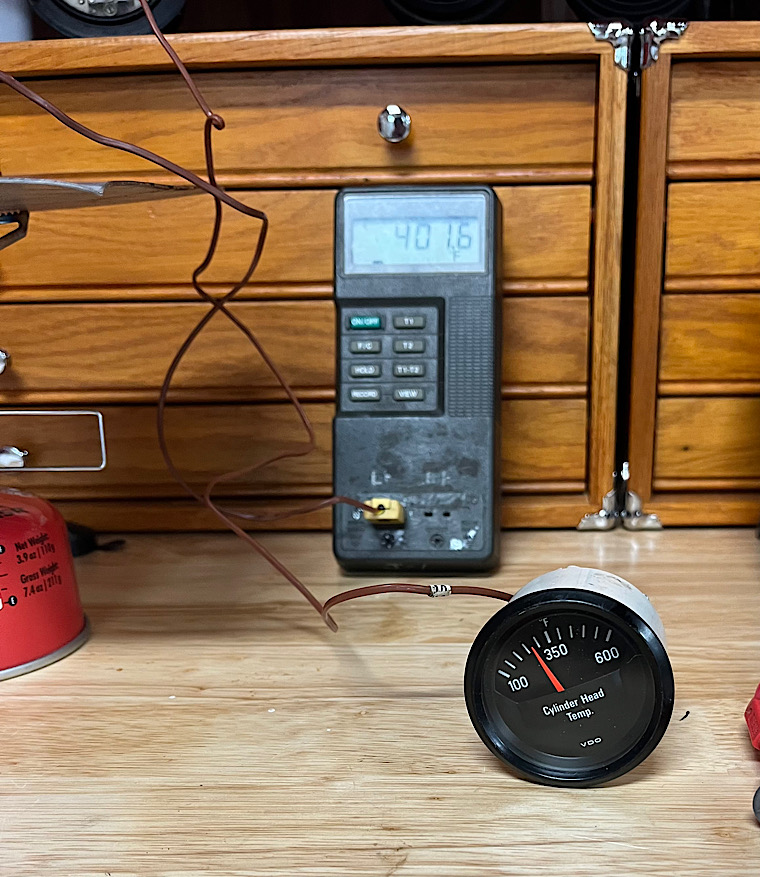 Takeaway: If the VDO gauge is supposed to run a type J TC, use of a K type would be expected to read low. This seems to be the case. Yeah - I know I need to apply some cold junction compensation to get a more accurate reading but that won’t get it to 400F using this k type TC. Next: I need to get some J type TC wire and repeat. Will also be able to figure out at that point what VDO used for cold junction assumption. 0C (32F) is the standard but like everything else here I’ve seen conflicting information saying they may have assumed 75F or something around room temperature. I’ll wait to see what I get with a J-type TC before I make any assumptions of my own. [update] J type wire ordered but I won’t be able to get back to this until the end of the month at earliest. Will keep watching (IMG:style_emoticons/default/popcorn[1].gif) to see what VDO comes back with or what Frank comes up with in his comparison of his bolt sensor or DD replacement (which will likely be spot on). |
|
|
|
| frank_c |
Jul 18 2026, 10:55 PM
Post
#30
|
|
Member Group: Members Posts: 105 Joined: 29-December 24 From: Austin, TX Member No.: 28,542 Region Association: None |
QUOTE(Superhawk996 @ Jul 18 2026, 06:01 PM) If the VDO gauge is supposed to run a type J TC, use of a K type would be expected to read low. These test results are great - thanks very much for taking the time to run and post them. I agree with your "Takeaway" statement regarding the use of K-type sensor in a J-type gauge. Once my DD gauge gets here next week, I try some similar tests and also get a reading using the old mystery TC and a K-type TC that came with my multimeter. Regarding AI, we use it at work quite a bit now (and are highly encouraged to do so), but occasionally I like to challenge it by asking how to handle a corner case that is buried in a few sentences within tens of thousands of pages of technical specs (for which I already know the answer). What always amazes me is how confident AI is in its response that is nearly always wrong the first time. In one of my recent tests, AI came back stating that the "clean, unambiguous" answer was blah, blah, blah. And it was 100% wrong because at the start it mis-interpreted a series of linked tables from one of the specs, and it was a train wreck after that as it propagated that error forward. After you point out the mistake, AI apologizes profusely, then provides the correct "authoritative" answer (its words) (IMG:style_emoticons/default/smile.gif). I know it will only get better, but for now a human in the loop who possesses the other AI (Actual Intelligence) is still needed to check everything. |
|
|
|
| Montreal914 |
Jul 19 2026, 10:41 AM
Post
#31
|
|
Advanced Member Group: Members Posts: 2,174 Joined: 8-August 10 From: Claremont, CA Member No.: 12,023 Region Association: Southern California
|
Thanks for showing this test result! (IMG:style_emoticons/default/smilie_pokal.gif)
If the TC leads are run directly to the gauge, then the VDO will become a lot more usable as you can roughly establish the cabin ambiant temp and do the offset. The scale being 50 degrees anyway, it's not a very accurate readout. Much better than the engine bay connection where who knows what ambiant temp is there. I still think John Bell should make a nice cylinder head temp gauge in a 60mm case for the center console using one of those Adafruit type-K thermocouple signal amplifier with cold junction conpensation that outputs 0-5V. It could drive one of the gauge motion and set in a 0-500F scale on the gauge face. Silver button hand to top it off. (IMG:style_emoticons/default/sunglasses.gif) A few years ago, I told him the 914 crowd would defnitely enjoy a stock looking head temp gauge for the center console. Attached thumbnail(s) 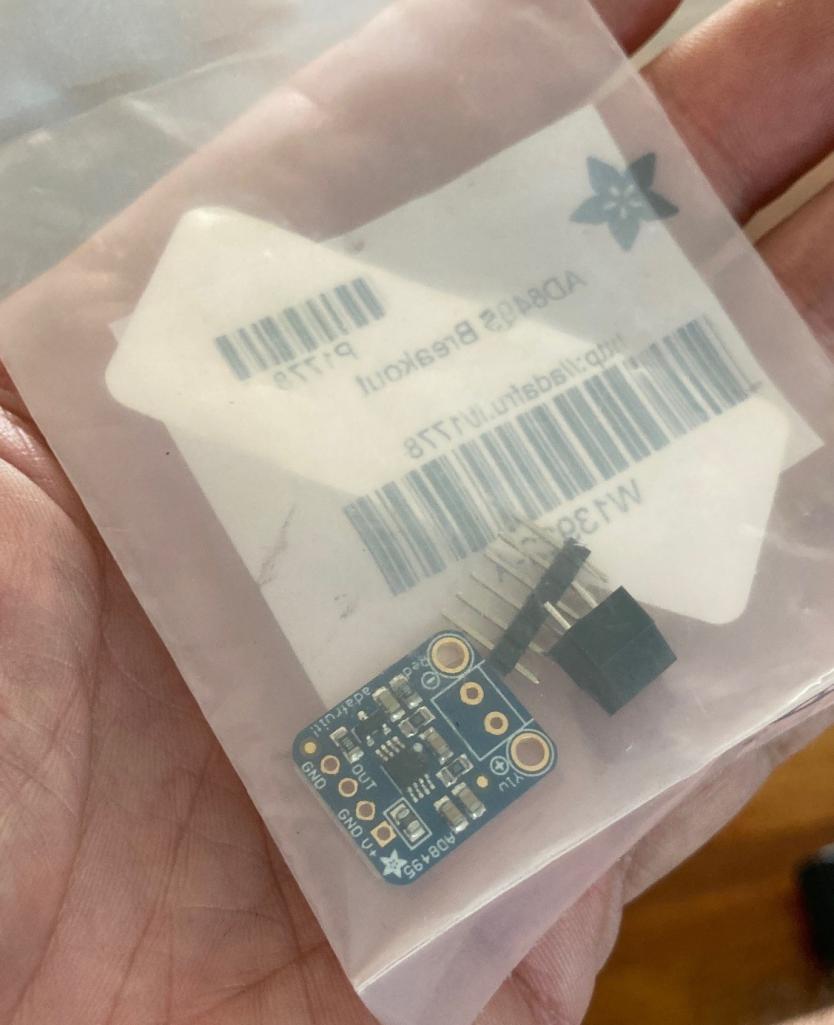
|
|
|
|
| Superhawk996 |
Jul 19 2026, 10:56 AM
Post
#32
|
|
914 Guru Group: Members Posts: 7,959 Joined: 25-August 18 From: Woods of N. Idaho Member No.: 22,428 Region Association: Galt's Gulch
|
QUOTE(Montreal914 @ Jul 19 2026, 12:41 PM) I still think John Bell should make a nice cylinder head temp gauge in a 60mm case for the center console using one of those Adafruit type-K thermocouple signal amplifier with cold junction conpensation that outputs 0-5V. It could drive one of the gauge motion and set in a 0-500F scale on the gauge face. Silver button hand to top it off. (IMG:style_emoticons/default/sunglasses.gif) That would be cool. Especially 60mm to match OEM console gauges. At this stage in the game there is no denying the Dakota Digital is more accurate. I just want a gauge that matches the beautiful analog VDO OEM gauges. |
|
|
|
|
2 User(s) are reading this topic (2 Guests and 0 Anonymous Users)
0 Members:

|
Lo-Fi Version | Time is now: 20th July 2026 - 08:45 PM |
Invision Power Board
v9.1.4 © 2026 IPS, Inc.